| Availability: | In stock | Condition: | new |
|
| Shipping: | starting at $0.00 | Warranty: | 2 Yrs |
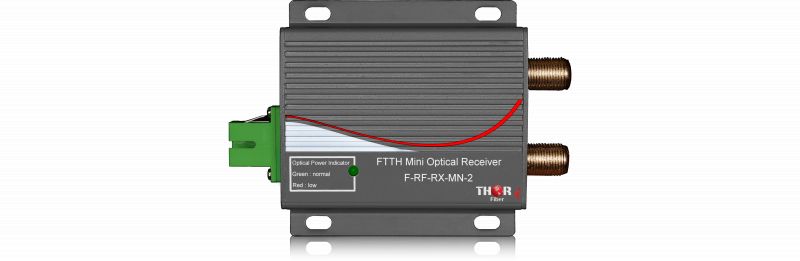
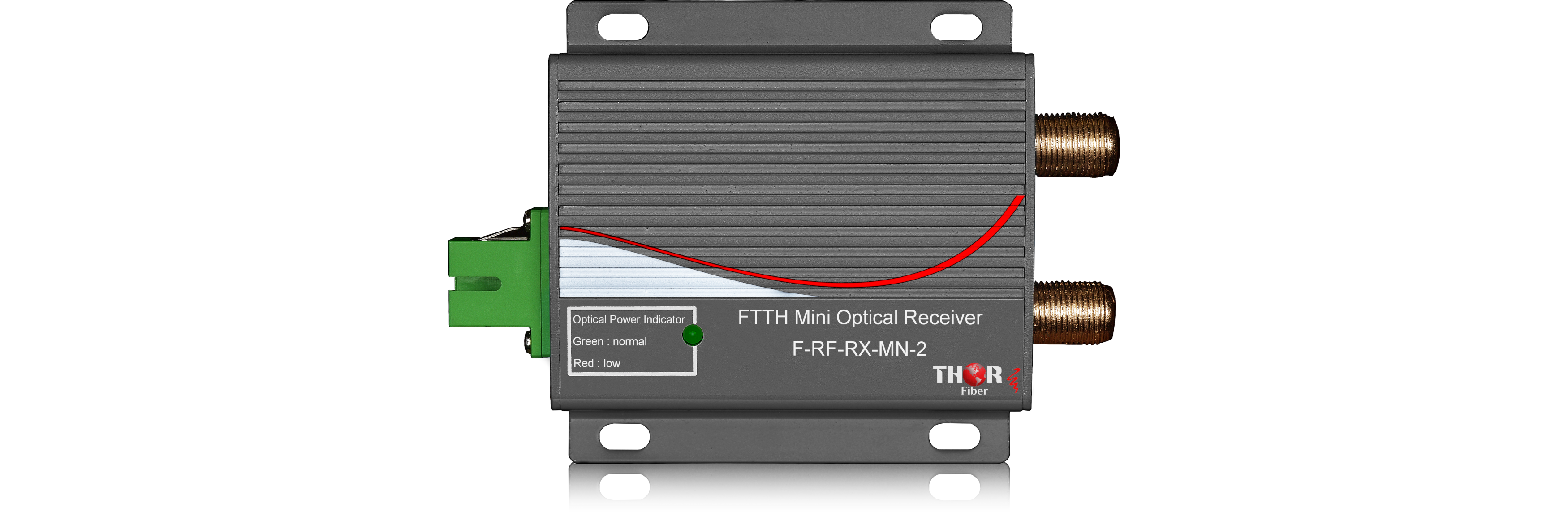
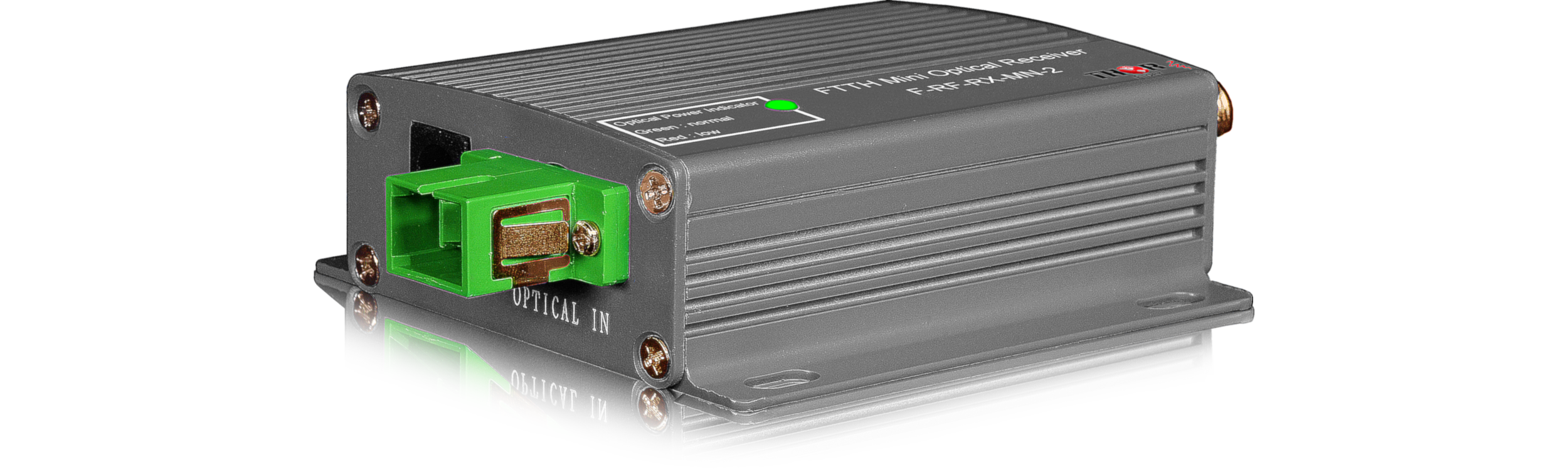
The Thor F-RF-RX-MN-2 is a CATV RF over fiber receiver designed as the RX end of a fiber-based RF distribution system. It receives an optically modulated RF signal generated by a CATV optical transmitter and converts it back into a standard electrical RF signal on coax.
This unit functions as an optical to RF converter, completing the RF over fiber link. The transmitter converts RF to light (TX side), and this receiver converts that light back to RF (RX side), allowing seamless transport of RF signals over fiber.
By using fiber instead of coax for long-distance runs, this system enables low-loss, noise-immune RF signal distribution while maintaining full compatibility with standard CATV and broadcast equipment at the receiving end.
The output RF signal can carry QAM, ATSC, DVB-T, and analog NTSC/PAL channels, making it ideal for TV CATV, MATV, hospitality distribution systems in hotels, apartment buildings, campuses, headends, and commercial AV installations.
With its compact design, stable performance, and seamless integration into existing coax systems, this receiver provides a reliable solution for extending RF services over fiber while maintaining compatibility with standard television and broadcast distribution equipment.
In a typical installation, an RF signal is first converted to light by a compatible optical transmitter and sent over fiber. At the far end, the F-RF-RX-MN-2 receives that optical signal and converts it back into RF so it can be delivered over coax to end equipment. This is useful in hotels, apartment buildings, campuses, stadiums, houses of worship, broadcast sites, and commercial AV systems where a designer wants to carry RF channels over longer distances than coax alone can handle. The result is a simple way to extend and distribute RF content while keeping compatibility with standard coax-based TV and CATV hardware.
IMPORTANT NOTE:
It is very important to interface this unit using an SC/APC (Angled Polished Connector) to avoid optical reflections.
If your fiber is terminated with SC, ST, or FC/PC (flat connectors), you must use an optical jumper to convert from PC to SC/APC for proper operation.
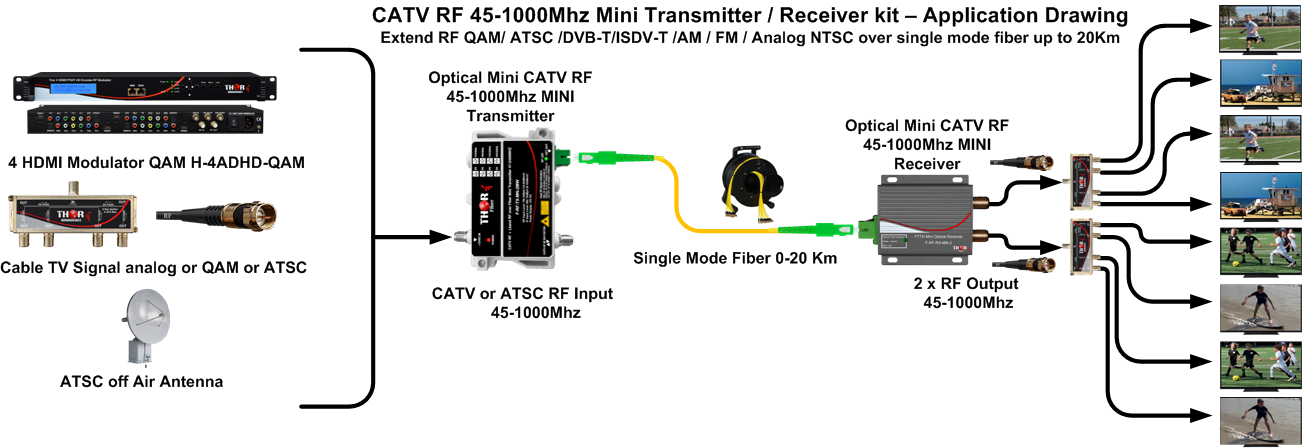

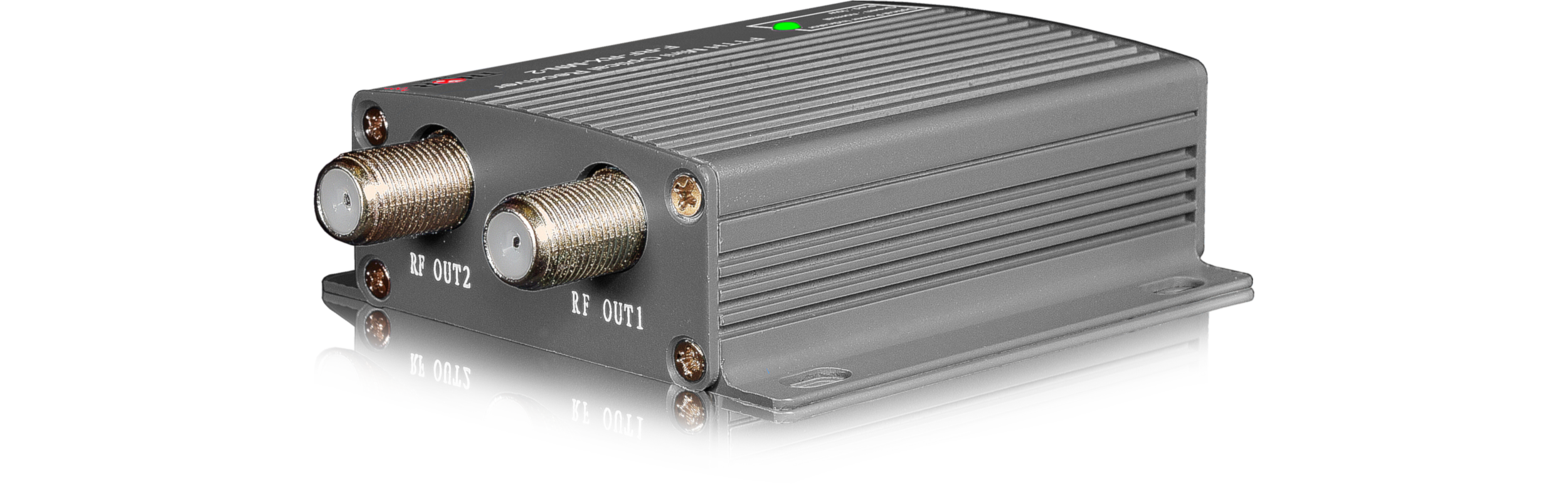
F-RF-RFMN-2 Mini RF receiver with dula Coaxial output
Pair this receiver with the matching transmitter: F-RF-TX-MN-2 RF Fiber Transmitter
Browse more: CATV and RF Over Fiber Products
Additional CATV RF fiber optic transmitter models are available for different optical power levels and network sizes. You can browse the full product family here: CATV RF over Fiber Transmitters
| F-RF-RX-MN-2 Specifications | |
|---|---|
| Light Wavelength | 1100 ~ 1700 nm |
| Operating Wavelength | 1100 ~ 1700 nm |
| Optical Input Power Range | 0 dBm to approximately -15 dBm (digital), 0 dBm to approximately -10 dBm (analog) |
| Frequency Range | 45 MHz to 1 GHz |
| Output Level | 65 to 75 dBμV (Optical Input: -6 dBm) 70 to 80 dBμV (Optical Input: -2 dBm) |
| Flatness | ±1 dB |
| Slope | 5 dB ± 2 dB |
| Return Loss | 16 dB |
| Noise Figure | 47.5 dB |
| CTB | ≥65 dB |
| CSO | ≥65 dB |
| MER | 38 |
| Power Consumption | ≥ 0.6 W |
| Test Conditions | 60 CH (PAL-D), Pin -6 dBm, 1 EDFA with noise figure 5 dB, 25 km, Composite OMI 18.5% |
| Output Impedance | 75 Ω |
| Output Port Number | 1 |
| RF Connector | F (female) |
| Responsivity | ≥ 0.9 A/W @ 1550 nm |
| Optical Return Loss | ≥ 55 dB |
| LED Indicator | Alarm LED: Green on = receive power in range (about -6 to 0 dBm), Red = low (< -8 dBm) or lost signal Power LED: Red = Power on |
| Power Adapter | Input Voltage: 90 to 250 V AC @ 50 to 60 Hz Output Voltage uncertainty ≤ 3% without load Continuous current ≥ 90% nominal current ±5% nominal DC voltage Ripple Voltage (Vpp) ≤ 150 mV Voltage surge arrester equipment integrated |
| Housing Material | Stainless metal with wall-mount flange |
| Working Environment | Operating temperature: -20°C to +55°C |
| Size (W × D × H) | 36 × 76.5 × 23 mm |
The Mini Transmitter (TX) and Mini Receiver (RX) are plug-and-play devices, provided that:
1) Power Connection
Connect the power supply to the transmitter.
2) RF Input Connection
Connect the CATV RF input to the F-type connector.
Ensure the RF input level is within 15–25 dBmV (75–85 dBµV).
3) Fiber Connection
Connect the fiber optic cable to the transmitter output.
WARNING: Never look directly into the optical output (risk of eye injury)
4) Optical Level Adjustment (Important)
Typical fiber losses:
5) TX Status Check
The transmitter LCD should display “ON”, indicating proper optical transmission.
1) Power Connection
Connect the power supply to the receiver.
If no optical signal is present or the level is too low, the LED will be RED.
2) RF Output Connection
Connect the CATV RF output from the F-type connector.
Typical RF output level: ~22 dBmV (82 dBµV)
3) Fiber Input Connection
Connect the fiber optic cable to the receiver input.
WARNING: Never look directly into the fiber jumper
4) Optical Input Level
The optical input level at the receiver should be between:
+2 dBm to -6 dBm
5) LED Status Behavior
Additional Notes:
1) It converts a fiber optic signal into an electrical RF signal on coax so it can be used by televisions and other RF distribution equipment.
2) It is suited for RF systems carrying formats such as QAM, ATSC, DVB-T, and analog NTSC/PAL. Many buyers also search for this type of unit for ATSC 3.0 and ISDB-T style applications.
3) Fiber allows RF signals to travel longer distances with lower loss and stronger immunity to electrical interference than long coax-only runs.
4) The RF output can feed TVs, coax splitters, amplifiers, RF distribution networks, and other compatible CATV or broadcast equipment.
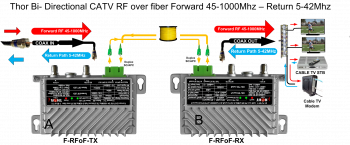 COAX Cable Bi-Directional CATV RF Transmitter and Receiver over fiber - 45-1000Mhz Forward and Return Path 5-42Mhz
Coax Cable over fiber - Uniquely designed Bidirectional CATV over Fiber Set. It was designed to replace Point to Point Coax cable since CATV requires bi-directional communication, this transceiver units provide service over Coax cable that have 2 different components (CATV + Internet)
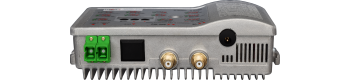 Optical Mini-node - CATV RF Receiver with Return Path - High RF Output Power 48dBmV
Fiber to the home mini-node -CATV RF 45-1000Mhz Receiver with Return Path RF 5-45Mhz Optical Transmitter on the separate optical port.

 ES
ES