| Availability: | In stock | Condition: | new |
|
| Shipping: | starting at $0.00 | Warranty: | 2 Years |
Compact RF over Fiber transport for analog TV, digital QAM, ATSC, and broadband CATV distribution over single-mode fiber.
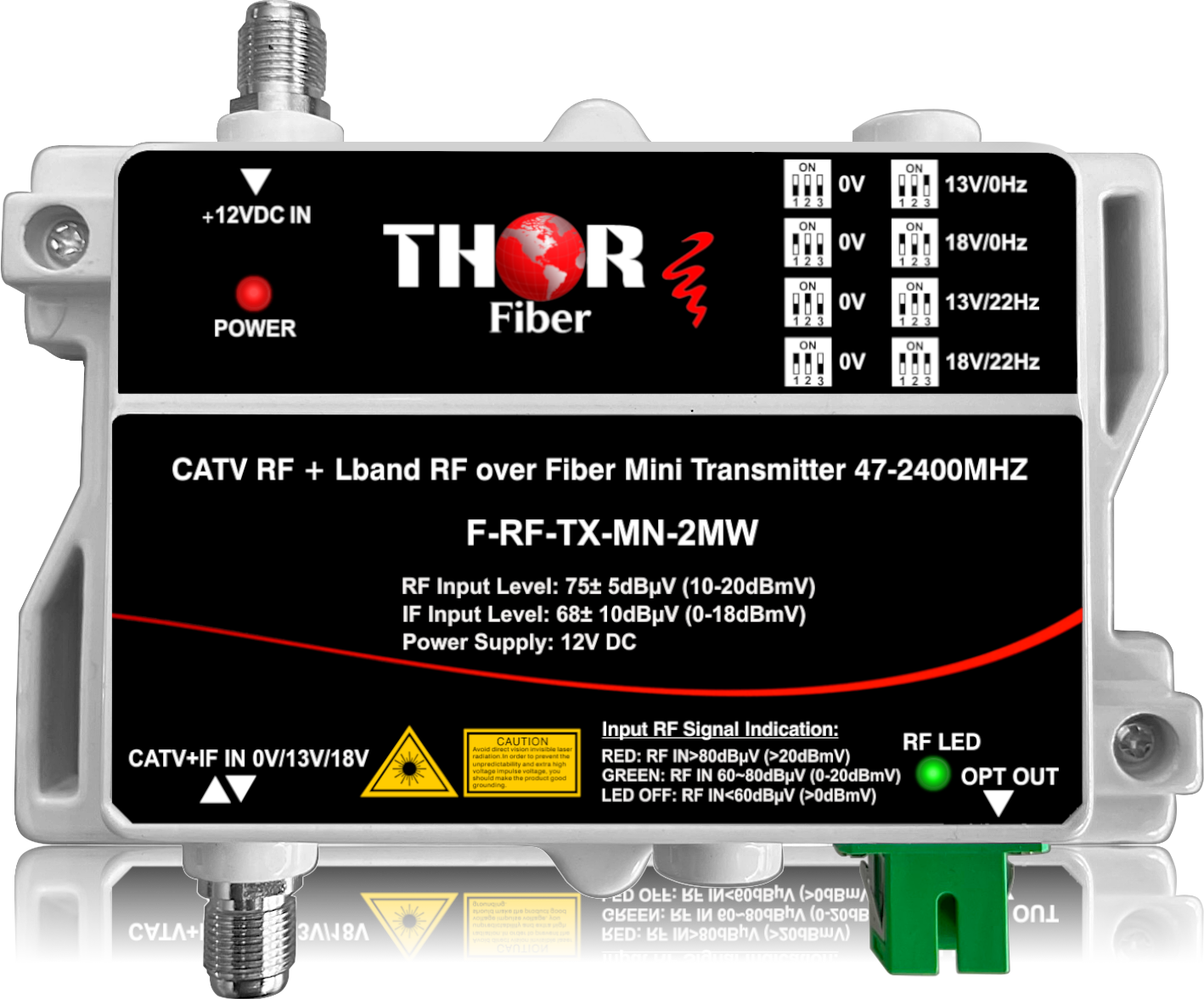
The Thor Portable 2mW CATV RF over Fiber Optical Transmitter is a compact and dependable solution designed to transport 45-1000 MHz RF signals over single-mode fiber for short- to medium-distance distribution networks. It is ideal for carrying analog TV channels, digital QAM, ATSC off-air signals, and broadband CATV services from a headend or source location to a remote building, communications room, rack, or optical node.
Built for users who need a small, efficient, and easy-to-deploy RF optical transmitter, this portable unit combines a high-linearity DFB laser with stable internal control electronics to preserve signal quality across the full CATV band. The result is clean RF transport with low distortion, making it well suited for hospitality systems, MATV installations, private coax networks, test benches, temporary broadcast setups, and in-building RF extension projects.
Unlike bulky headend equipment, this mini transmitter is designed for installations where space is limited but performance still matters. It can be used as a point-to-point optical RF link or as part of a larger RF over Fiber architecture that includes rack mount CATV RF receivers, mini nodes with return path, and PLC optical splitters.
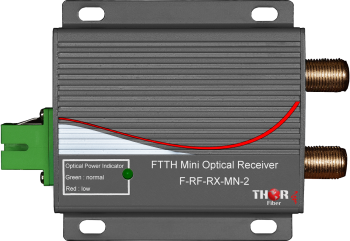
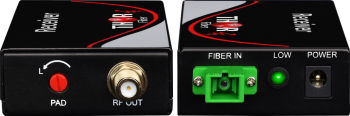
The F-RF-TX-MN-2 transmitter can be used with multiple Thor Fiber optical RF receivers, depending on your RF output requirements and system design.
Important: This product is an optical transmitter (TX) only.
For a complete working system, it is commonly paired with a matching optical receiver and sold as a TX + RX kit (F-RF-TX/RX-MN).
The full kit enables point-to-point CATV RF transmission over fiber between headend and remote locations.
For best performance, use SC/APC optical connectors. If using SC/ST/FC-PC connectors, a PC to APC jumper is recommended to reduce reflections.
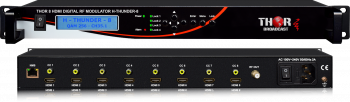
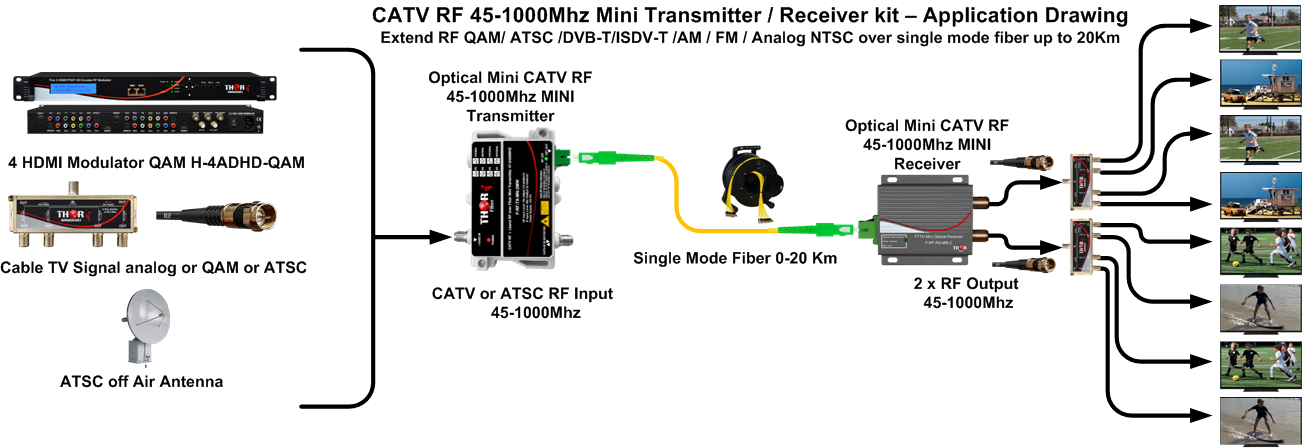
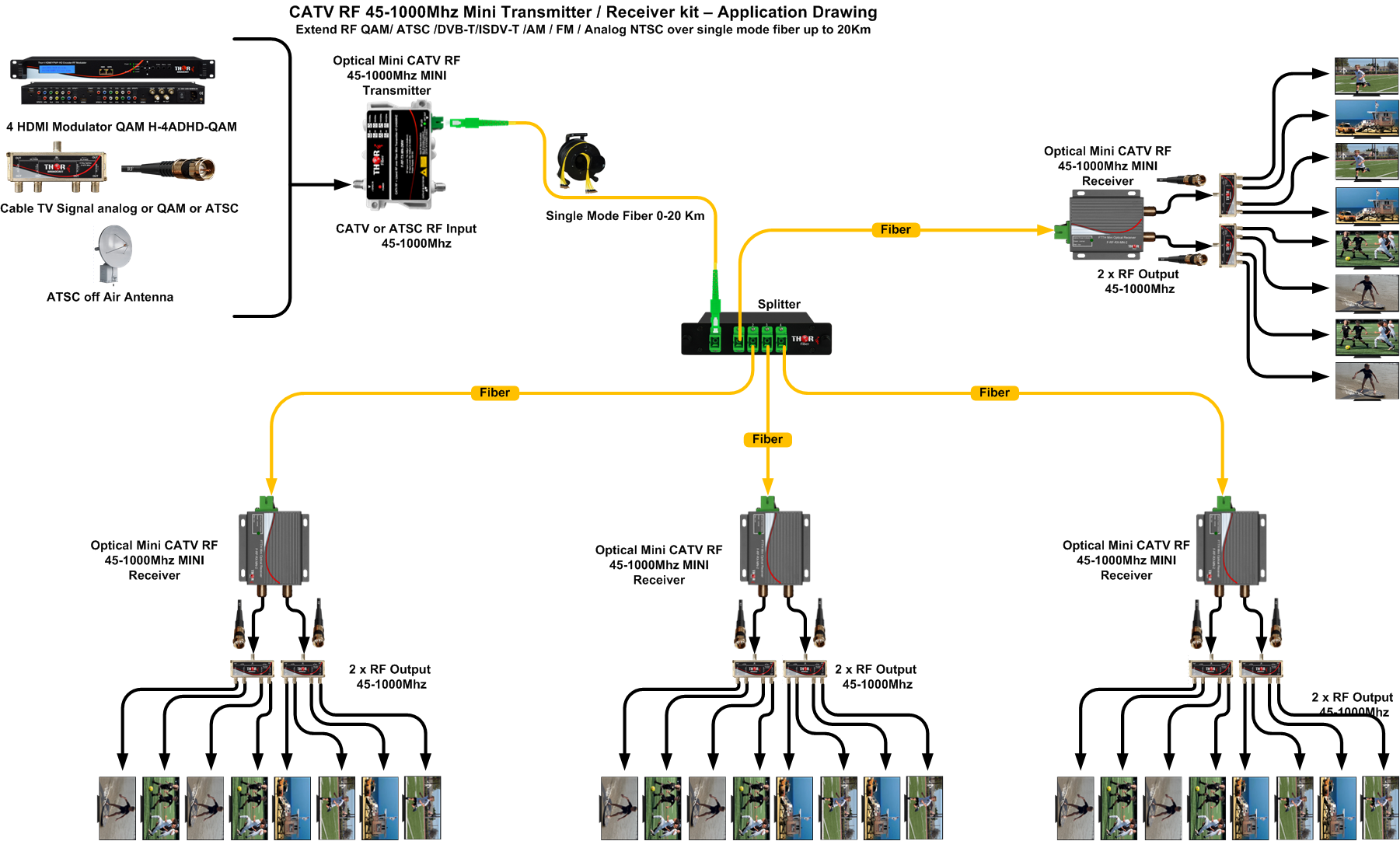
HDMI sources feed a Thor modulator, which converts signals into RF channels. The RF is transmitted over fiber, split across multiple locations, and converted back to coax for TVs or amplifiers.


This product page is for the transmitter only (TX). A matching Transmitter + Receiver kit is also available for complete point-to-point CATV RF over fiber transport.
Important: This listing is for the optical transmitter only.
For customers who need a complete working optical link, this unit is also commonly purchased as a Transmitter + Receiver kit, which allows point-to-point CATV RF transmission over fiber.
The complete kit part number is F-RF-TX/RX-MN, which includes both the optical transmitter and the matching optical receiver.
Additional CATV RF fiber optic transmitter models are available for different optical power levels and network sizes. You can browse the full product family here: CATV RF over Fiber Transmitters
While this page is for the TX only, many customers purchase the complete F-RF-TX/RX-MN kit, which includes both the transmitter and receiver for a full point-to-point CATV RF over fiber link.
Optical transmitter only
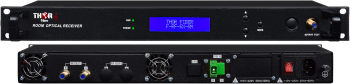
Matching optical receiver
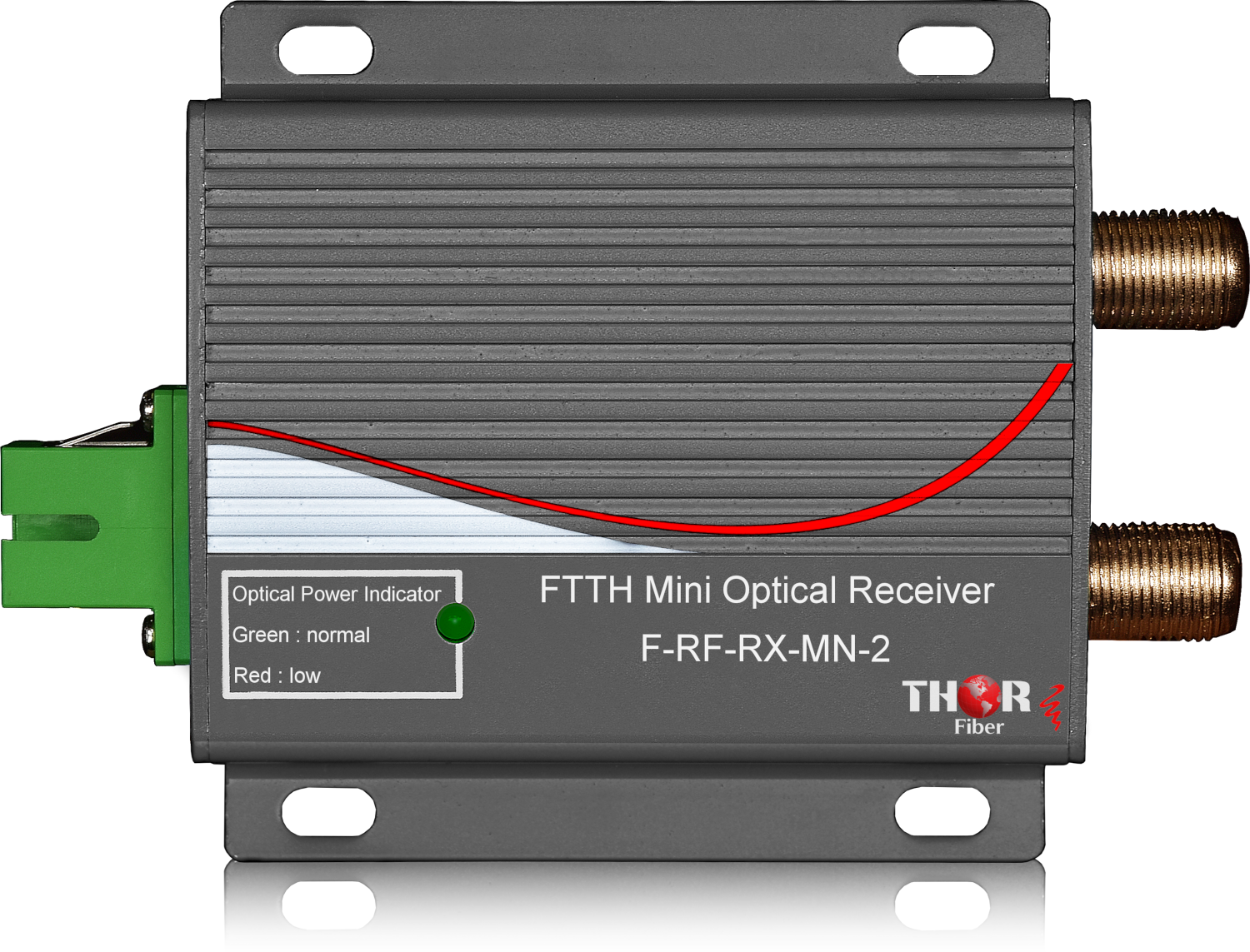
Complete kit part number: F-RF-TX/RX-MN
Includes: 1 × optical transmitter + 1 × matching optical receiver
The Thor F-PLC passive fiber optic splitter with SC/APC connectors is an ideal accessory for CATV RF optical transmitters, allowing one optical signal to be split and routed to multiple locations over fiber. Available in 1x2 to 1x64 versions, it is perfect for RF over fiber distribution systems in hotels, campuses, apartment buildings, and other multi-location installations.
Learn more about Thor F-PLC Splitters →
| Item | Unit | Technical specification |
| Wavelength | nm | 1310nm +/- 20 |
| Laser type | DFB laser | |
| Optical modulation type | Direct optical strength modulation | |
| Optical connector type |
SC/APC IMPORTANT NOTE*** (it is very important to interface our unit with SC/APC - Angle Polished Connector to avoid any light reflections. If your fiber is terminated with the SC, ST, FC /PC flat connector, you need to use an optical jumper from PC type to SC/APC for proper conversion. |
|
| Frequency range | MHz | 45-862/1000 |
|
RF input level |
dBuV |
72~82 |
| Flatness in band | dB |
+/-0.75 |
| RF input resistance | 75 | |
| Input reflection loss | dB |
>=16 |
| Link C/N | dB |
>=51 |
| Link C/CSO | dB |
>=60 |
| Link C/CTB | dB |
>=65 |
| AGC controlling range | dB | +/-5 |
| MGC controlling | dB | 0~10 |
| Power Supply | V | 12V DC / 1.5A AC to DC power supply - Included ( F-Type Female coax connector) |
| Power Loss | W |
<= 8 |
| Size / Weight | WEIGHT: 1.0 lb BOX SIZE (IN): 8 x 5.5 x 1.75 in BOX SIZE (MM): 204 x 140 x 45 mm UNIT SIZE (IN): 5.25 x 4.25 x 1.5 in UNIT SIZE (MM): 134 x 108 x 39 mm |
Quick Installation guide
The Mini Transmitter and Mini Receiver set are plug-and-play devices if the RF input power to the TX and optical power input to the RX are in the specified range.
TX RF INPUT 15-25dBmV (75-85dBuV) RX Optical INPUT should be +2 - 6dBm
TRANSMITTER:
1) Connect Power Supply to the Transmitter
2) Connect CATV RF Input to the F port connector - Please note, the RF power should be between 15-25dBmV (75-85dBuV)
3) Connect fiber optic cable to the Mini Transmitter Output - The connector type MUST be SC/APC, never use SC/PC (Blue flat connector) NEVER LOOK DIRECTLY INTO THE UNITS OPTICAL OUTPUT (you could burn your eye)
4 ) For short-distance, point-to-point transmission, please plug 5db fiber optic attenuator, included in the box. (if the transmitter is used with a fiber optic splitter, the attenuator is not needed due to splitters insertion loss). The fiber loss is about 0.35db/km in 1310nm wavelength there is also some slight loss in path panel junctions typically 0.1 -0.5db per junction
5) The TX should show "ON" on the LCD, meaning it is transmitting and outputting an optical signal.
RECEIVER:
1) Connect POWER Supply to the Receiver, "No Light Input" or "Level too Low" the LED will be RED
2) Connect CATV RF cable to the F port connector - RF Output, the output will be about 22dBmV (82 dBuV)
3) Connect fiber optic cable to the Mini Receiver INPUT - The connector type MUST be SC/APC, never use SC/PC (Blue flat connector) NEVER LOOK DIRECTLY TO THE FIBER JUMPER. (You will burn your eye)
4) The optical level by the receiver should be about +2 to -6dBm
5) The LED should turn from RED to GREEN
5a) The RED LED means no Link Light detector
5b) The red light might also mean saturation, LEVEL TOO HIGH, it is easy to determine when you plug in the optical jumper the unit will go from RED to GREEN to RED again, it means the optical level is higher than +2Dbm , the receiver will still work correctly if this level will be not higher than +5dbm, If higher then +5, please add 5db attenuator included with your purchase.
A 2mW optical transmitter is often the right choice for portable links, shorter fiber paths, and smaller RF distribution systems. It gives integrators a practical, lower-cost way to move RF channels over fiber without introducing the signal loss and interference problems that are common with long coax runs. For many projects, this means easier installation, better signal stability, and cleaner expansion to remote areas of a campus, hotel, apartment building, stadium zone, or commercial facility.
It is especially useful when paired with a source such as the H-THUNDER-8 HDMI to RF modulator, allowing RF channels generated at the headend to be transported over fiber and then converted back to coax RF near the destination TVs or distribution amplifiers.
In a typical deployment, the RF signal originates from a CATV headend, antenna system, or RF modulator. For example, a Thor H-THUNDER-8 can generate digital QAM or ATSC channels from HDMI sources. Those RF channels feed this portable 2mW optical transmitter, which converts the RF spectrum into an optical signal for transmission over fiber.
At the far end, the optical signal is converted back to coaxial RF by a rack mount CATV RF receiver or a mini-node with return path. The recovered RF can then feed televisions directly, launch into a building coax network, or connect to amplifiers and splitters for wider in-building distribution.
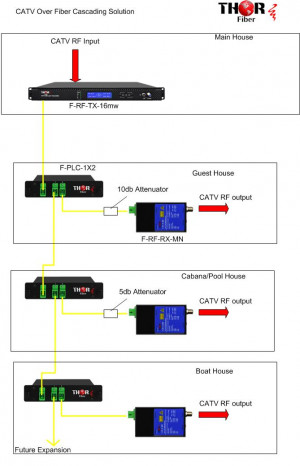
When one optical feed needs to serve multiple destinations, the signal can also be distributed through Thor F-PLC optical splitters, depending on the optical power budget and system design.
| Parameter | Specification |
|---|---|
| Product Type | Portable CATV RF over Fiber Optical Transmitter |
| RF Frequency Range | 45-1000 MHz |
| Optical Output Power | 2mW |
| Laser Type | High-linearity DFB laser |
| Supported Signal Types | Analog TV, Digital QAM, ATSC, CATV broadband RF |
| Fiber Type | Single-mode fiber |
| Typical Link Distance | Short to medium range deployment, depending on system optical budget |
| Deployment Style | Portable, compact, point-to-point or small RF over Fiber systems |
The portable 2mW CATV RF over Fiber transmitter is an excellent choice for compact RF transport systems where integrators need a simple, reliable, and professional way to move broadband RF over fiber. It is especially effective in systems carrying QAM or ATSC channels from a central source to remote coax distribution points.
So it's RF; what kind of RF?
- https://thorbroadcast.com/product/thor-optical-mini-catv-rf-transmitter-45-1000mhz.html
The receiver can be either of these
https://thorbroadcast.com/product/thor-fiber-optical-mini-ftth-rf-catv-cable-tv-receiver-8230.html
https://thorbroadcast.com/product/rf-catv-mini-optical-receiver.html
- No problem. There are different types of RF; these particular units are specifically for QAM
- It will transport the entire RF CATV range as well.
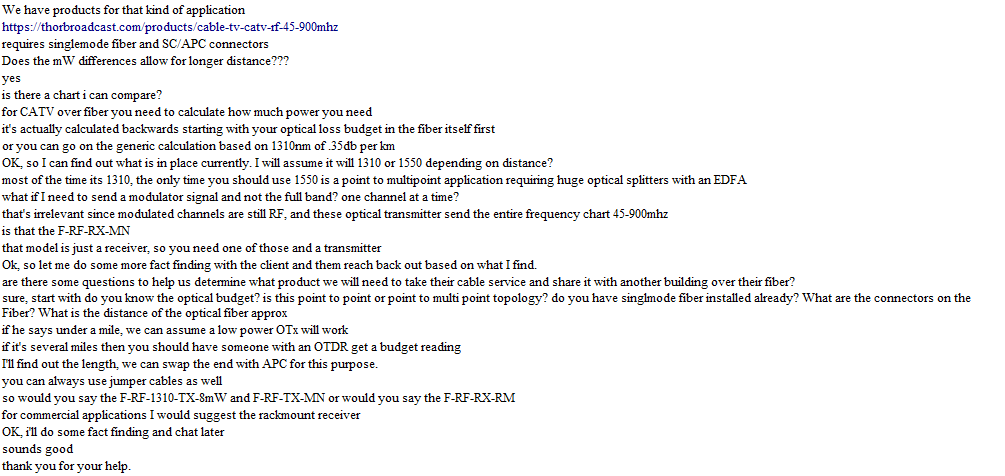
The rules are: Our fiber-optic RF CATV Transmitter and Receiver need to be connected with single-mode fiber terminated with SC/APC connectors - this is very important RF input power to the F-RF-1310-TX-4mW needs to be +15 - +25dbmv Optical input power range into Receiver F-RF-RX-RM is +3 - -5dBm Receiver outputs +45dBmv RF power in this optical input +3 - -5dBm range You should have the RF output with OP +1.6 dBm, so something is wrong. Are you using single-mode fiber end to end? Are you interfacing our equipment with SC/APC fiber connectors?
Are you trying to get it to work with a Cable TV Set-Top Box (STB)? There might be a couple of things to check:
Please measure the RF input power. It needs to be between 15-30 dBmV.
Additionally, many cable companies use a return path (5-45 MHz) in the reverse direction for communication and registering the box with the cable TV headend.
Please perform the following test:
Connect the STB directly to the coax cable (bypassing the optical equipment) and check if you receive content.
Without removing power from the STB, connect it through the Optical TX and RX units.
If it works in this setup, it means your system requires bi-directional RF:
Forward path: 45-1000 MHz
Return path: 5-45 MHz
If that's the case, you will need this unit:
F-RFoF-TX/RX
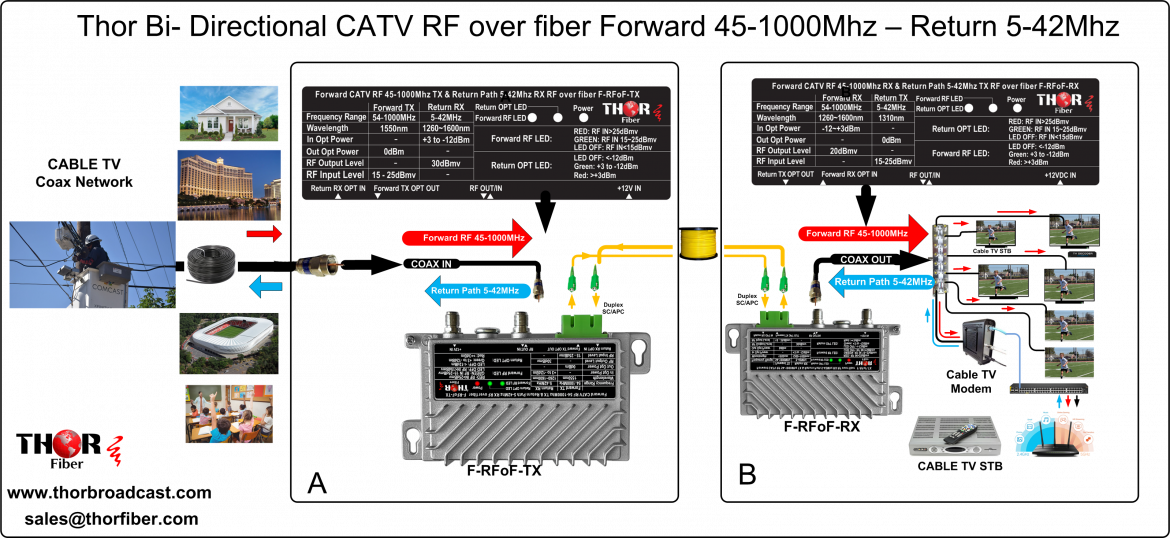
That makes sense - we do have a solution for this:
F-RFoF-TX/RX - (TX + RX kit / both ends) https://thorbroadcast.com/product/coax-cable-bi-directional-catv-rf-transmitter-and-receiver-over-fiber-8230.html
Please note: two single-mode fiber strands are required. The fiber optic interface is SC/APC (green, angled polish). If you do not have SC/APC fiber, please use SC/PC to SC/APC conversion patch cables.
Also, an RF spectrum analyzer will be very helpful during installation, since the optical transceivers require an RF input level of +15 to +25 dBmV. In many cases, the modem output level needs to be adjusted to meet this RF window (either internally or externally using passive attenuators).
Please let me know if this is clear.
The transmission distance depends on the transmitter optical output power and the operating input range of the optical receiver. For this unit, the transmitter optical output is approximately +2 dBm. If the receiver sensitivity is approximately -5 dBm, the total optical budget is about 7 dB.
This means the total allowable loss in the optical link - including fiber attenuation, patch panels, connectors, and any passive optical components - should remain within that 7 dB budget.
As a general reference, single-mode fiber at 1310 nm has a typical loss of about 0.35 dB/km. Additional losses must also be considered for optical connectors, patch points, and splice or panel transitions.
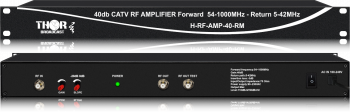 40db CATV RF Amplifier Forward 54-1000MHz - Return 5-42MHz
The Thor 40dB CATV Distribution Coax Amplifier supports 54-1000MHz analog RF, Cable QAM, ATSC, DVB-T, and ISDB-T 19" rack-mountable - bi-directional
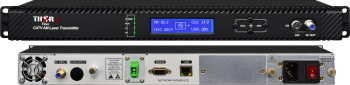 16 mW CATV RF Over Fiber Tx 45-870 MHz
16 mW fiber optic RF transmitter for television carrier signals or any other RF in the 45-870 MHz band. Transmits full-band signals with linear response.

 ES
ES